# How Do Organizations Adopt AI Successfully?
Canonical source: [https://isaiuseful.com/adoption](https://isaiuseful.com/adoption)
Organizational AI adoption
AI adoption is not a technology project. It is an organizational transformation journey—one that starts by helping people find value in the work they already do.
Platforms, models and architecture matter later. First create the conditions for learning, then turn useful discoveries into reliable ways of working.
- [See the five stages](#journey)
- [Find the scaling breakpoint](#engineer)
- [See adoption metrics](#adoption-evidence)
Transformation map
Value compounds in sequence
1. 01 **Crawl** Learn safely
2. 02 **Walk** Prove value
3. 03 **Engineer** Make it repeatable
4. 04 **Run** Scale what works
5. 05 **Fly** Keep accelerating
How do we help thousands of people adopt AI successfully **without turning it into chaos?**
- [**16.3%** working-age global diffusion MICROSOFT ESTIMATE · H2 2025](#adoption-evidence)
- [**88%** organizations using AI AT LEAST ONE FUNCTION · 2025](#adoption-evidence)
- [**32.7%** EU individual use EUROSTAT SURVEY · 2025](#adoption-evidence)
The AI adoption journey
## What are the five stages of AI adoption?
Each stage has a different job. Applying enterprise controls too early suppresses discovery; scaling before a workflow is reliable multiplies inconsistency.
- [01 **Crawl** Curiosity & experimentation](#crawl)
- [02 **Walk** First proven business value](#walk)
- [03 **Engineer** Repeatable & governed workflow](#engineer)
- [04 **Run** Organization-wide scaling](#run)
- [05 **Fly** Continuous innovation](#fly)
The sequence
**Discover value** **prove it** **make it repeatable** **scale it** **keep improving it**
Curiosity before ROI
## Stage 1: How do you start AI adoption safely?
The goal is not measurable business value yet. The goal is organizational learning.
Give employees a safe place to explore, test ideas and notice where AI removes friction from everyday work. Keep the cost of trying small—and the permission to learn wide.
### Make experimentation ordinary
- Write and improve documents
- Summarize meetings and research
- Create presentation first drafts
- Assist with code and analysis
- Brainstorm, reframe and ideate
### What good looks like now
- Wide experimentation is encouraged
- Useful stories are collected and shared
- Individuals remove small points of friction
- Formal ROI is not the admission ticket
- Governance does not become a blanket blocker
Success metric
People stop asking “What is AI?” and start asking **“Can AI help me with this task?”**
Better, faster or cheaper
## Stage 2: How do you prove one valuable AI workflow?
Experimentation becomes adoption when one workflow clearly outperforms the old way of working.
Find one outcome valuable enough that the team would not willingly return to the previous process. It does not need to save millions; it needs to matter to the people doing the work.
### Choose a bounded workflow
Release notes
Social content
Meeting summaries
Support drafts
Knowledge search
Sales proposals
The proof test
Is the new workflow meaningfully **better** , **faster** or **cheaper** after review and correction?
Compare it with a real manual baseline. Use the [evidence claim boundary](https://isaiuseful.com/evidence.html.md#claim-boundary) to keep a narrow result narrow, then choose a [task-relevant benchmark or local test](https://isaiuseful.com/benchmarks.html.md#database) . A persuasive demo is not the same thing as a dependable result.
Success metric
A team can point to a specific workflow and say: **“We would not go back to doing this manually.”**
The scaling breakpoint
## Stage 3: How do you make AI workflows repeatable?
A good pilot is not a process. This is where isolated success becomes transferable capability.
**Most initiatives stall here.**
The pilot works because a few enthusiasts carry hidden knowledge. Remove that dependency before expanding.
### Make the workflow explicit
1. Input What enters the process?
2. Output What does “good” look like?
3. Owner Who is accountable?
4. Control What requires human review?
5. Failure What happens when AI is wrong?
6. Measure How will success be tracked?
### Build the operating layer
- Workflow and exception design
- Prompt and input standardization
- Human review and escalation paths
- KPIs, acceptance tests and quality checks
- Security, compliance and data review
- Clear governance proportional to risk
Perfection is not the goal. Consistency across people is. For software delivery, the [Thinking with AI workflow loop](https://isaiuseful.com/thinking-with-ai.html.md#loop) makes these controls reviewable.
Success metric
The process works reliably **regardless of which trained employee executes it.**
Scale proven value
## Stage 4: How do you scale AI across an organization?
Once the workflow is proven and repeatable, expand the pattern—not merely access to a tool.
Look for adjacent workflows across departments, standardize the reusable parts and measure realized benefits. AI now moves from individual productivity improvement to enterprise capability; multi-system operational work may need the interfaces and ownership model in the [sovereign operational-intelligence stack](https://isaiuseful.com/diy-palantir.html.md#stack) .
Sales
**Proposal generation**
Customer service
**Assisted responses**
HR
**Recruiting workflows**
Finance
**Assisted analysis**
Development
**Coding assistants**
01
**Adoption**
Change management that starts with the work
02
**Enablement**
Role-specific training and reusable playbooks
03
**Standards**
Shared platforms, controls and support
04
**Benefits**
Measured outcomes, not usage vanity metrics
Success metric
Multiple teams achieve measurable outcomes using **standardized AI-enabled processes.**
Center of Excellence
## Stage 5: How does an AI Center of Excellence help?
When AI becomes a core capability, give it dedicated leadership without creating a central bottleneck.
The operating principle
The CoE is an accelerator , not a gatekeeper.
It helps teams move faster and more safely by making scarce expertise, standards and reusable patterns available to everyone.
01
**Strategy** Set direction and prioritize opportunity
02
**Governance** Define policy proportional to impact
03
**Architecture** Guide platforms, patterns and vendors
04
**Enablement** Train people and spread practice
05
**Measurement** Track value and improve the portfolio
06
**Innovation** Evaluate what becomes possible next
Success metric
AI becomes an embedded capability that **continuously creates value across the organization.**
Key principle
## How do you build repeatable AI adoption capability?
The durable advantage is not access to a model. It is the organizational system that repeatedly turns useful ideas into dependable outcomes.
### People
Give employees permission to learn, role-specific support and a voice in redesigning their work.
### Process
Define ownership, quality, exceptions, approval boundaries and measures before expanding.
### Technology
Choose platforms and models that fit the proven workflow, its data and its risk—not the other way around.
Useful discovery
Repeatable workflow
Responsible scale
**Competitive advantage**
Adoption in numbers
## How widely is AI actually being used?
Population use, organizational surveys, active users, web visits and revenue measure different layers of adoption. They are shown separately.
Worldwide diffusion
16.3%
Working-age population estimated to have used generative AI in H2 2025.
Microsoft telemetry-based estimate
Organizational breadth
88%
Surveyed organizations reporting AI use in at least one business function in 2025.
McKinsey survey via Stanford AI Index
EU individual use
32.7%
People aged 16–74 reporting generative-AI use in the previous three months.
Eurostat survey, 2025
> Visual: Geographic reach. AI adoption by country. Microsoft estimates working-age use; Eurostat surveys recent use among people aged 16–74. The datasets remain separate.
Geographic reach
### AI adoption by country
Microsoft estimates working-age use; Eurostat surveys recent use among people aged 16–74. The datasets remain separate.
- Dataset option: Global working-age estimate
- Dataset option: Europe individual survey
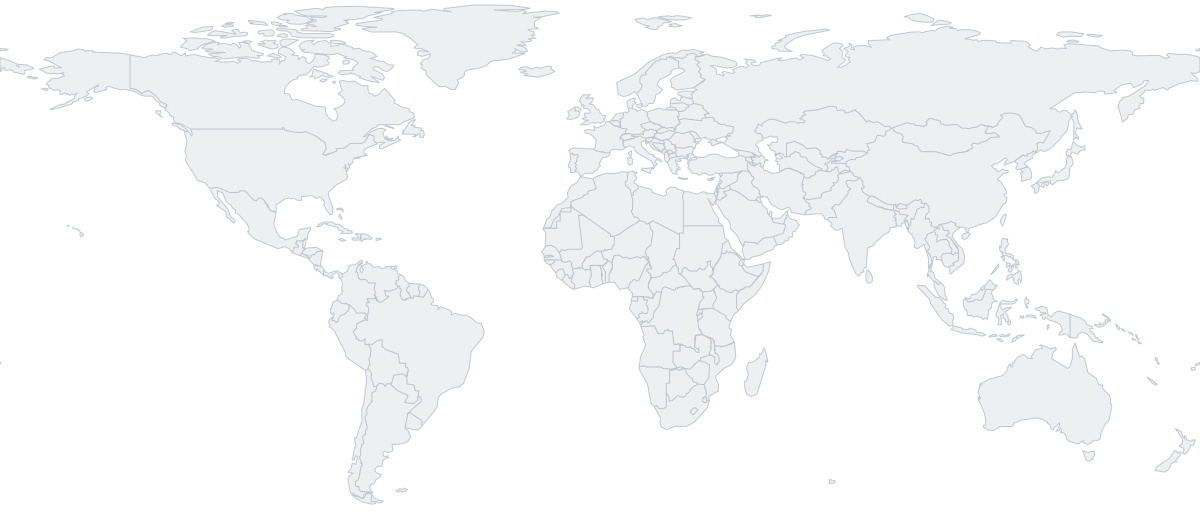
Loading the map values…
Microsoft estimate · H2 2025
**United States 28.3%**
Estimated share of the working-age population using a generative-AI product during the half-year.
Up 2.0 percentage points from H1 2025.
| Map layer | Reference point | Period |
| --- | --- | --- |
| Global estimate | **UAE 64.0%** | H2 2025 |
| Global estimate | **U.S. 28.3%** | H2 2025 |
| Europe survey | **Estonia 46.64%** | Previous three months |
| Europe survey | **EU 32.66%** | Previous three months |
> Visual: Inside organizations. Access is broad; depth still varies. In 2025, 88% reported AI use in at least one function and 79% reported regular generative-AI use.
Inside organizations
### Access is broad; depth still varies
In 2025, 88% reported AI use in at least one function and 79% reported regular generative-AI use.
Loading the HTML chart…
Source note, checked 31 July 2026: the Stanford chapter PDF and figure report 79% for generative AI; the chapter landing-page summary says 70%. This chart retains the figure value while the publisher’s pages disagree.
> Visual: The adoption gap. Using AI is much more common than measuring value. McKinsey reports 88% regular use, 39% with any enterprise-level EBIT impact and 6% meeting its high-performer threshold. These are separate signals, not a funnel.
The adoption gap
### Using AI is much more common than measuring value
McKinsey reports 88% regular use, 39% with any enterprise-level EBIT impact and 6% meeting its high-performer threshold. These are separate signals, not a funnel.
Loading the HTML chart…
**19.8%**
of all U.S. businesses used AI
**32.0%**
of firms with 100–249 employees
**37.0%**
of firms with 250+ employees
**39.7%**
in the information sector
**33.9%**
in finance and insurance
**≈14.0%**
in retail trade
Census BTOS, period ending May 3, 2026; use in any business function during the previous two weeks.
> Visual: Agent-product reach. Codex grew fast—then its distribution changed. OpenAI disclosed 1.6M+ Codex weekly users in February and 5M+ in June. The broader post-rollout series rose from 8M in July to 15M+ in August; it combines Codex with ChatGPT Work.
Agent-product reach
### Codex grew fast—then its distribution changed
OpenAI disclosed 1.6M+ Codex weekly users in February and 5M+ in June. The broader post-rollout series rose from 8M in July to 15M+ in August; it combines Codex with ChatGPT Work.
Loading the HTML chart…
First-party agent telemetry
### Codex and Claude Code behavioral samples
Vendor studies of task scope, work mix and human–agent control—not independent productivity audits.
Individual, organizational and OpenAI-user samples
**Users with ≥1 request >30 min** — 80.6%
**Users with ≥1 request >1 h** — 70.2%
**Users with ≥1 request >8 h** — 25.6%
Human-time equivalents estimate task scope, not time saved or business value.
≈400,000 interactive sessions from ≈235,000 people
**Active runtime per user** — 20 h/week
**Sessions involving code work** — 56%
**Human planning / Claude execution** — 70% / 80%
Excludes third-party IDE, SDK and headless usage; work types and decisions are classified.
Competitive attention
### ChatGPT leads tracked generative-AI web visits
This Similarweb-based series excludes embedded, app, API and enterprise use. It measures web attention, not total product reach.
Highlight
Loading the interactive HTML chart…
Exact chart data and definitions
### AI diffusion by economy
**Microsoft estimate of working-age generative-AI use**
| Economy | H1 2025 | H2 2025 | Change |
| --- | --- | --- | --- |
| United Arab Emirates | 59.4% | 64.0% | +4.6 pp |
| Singapore | 58.6% | 60.9% | +2.3 pp |
| Norway | 45.3% | 46.4% | +1.1 pp |
| Ireland | 41.7% | 44.6% | +2.9 pp |
| France | 40.9% | 44.0% | +3.1 pp |
| Spain | 39.7% | 41.8% | +2.1 pp |
| New Zealand | 37.6% | 40.5% | +2.9 pp |
| Netherlands | 36.3% | 38.9% | +2.6 pp |
| United Kingdom | 36.4% | 38.9% | +2.5 pp |
| Qatar | 35.7% | 38.3% | +2.6 pp |
| Australia | 34.5% | 36.9% | +2.4 pp |
| Israel | 33.9% | 36.1% | +2.2 pp |
| Canada | 33.5% | 35.0% | +1.5 pp |
| South Korea | 25.9% | 30.7% | +4.8 pp |
| Germany | 26.5% | 28.6% | +2.1 pp |
| United States | 26.3% | 28.3% | +2.0 pp |
| South Africa | 19.3% | 21.1% | +1.8 pp |
| Japan | 16.7% | 19.1% | +2.4 pp |
| Mexico | 16.7% | 17.8% | +1.1 pp |
| Brazil | 15.6% | 17.1% | +1.5 pp |
| China | 15.4% | 16.3% | +0.9 pp |
| India | 14.2% | 15.7% | +1.5 pp |
### Europe individual use
**Eurostat 2025 survey: people aged 16–74 using generative AI in the previous three months**
| Geography | Used generative AI |
| --- | --- |
| European Union | 32.66% |
| Euro area | 34.20% |
| Belgium | 42.01% |
| Bulgaria | 22.50% |
| Czechia | 35.35% |
| Denmark | 48.44% |
| Germany | 32.25% |
| Estonia | 46.64% |
| Ireland | 44.93% |
| Greece | 44.09% |
| Spain | 37.88% |
| France | 37.46% |
| Croatia | 27.52% |
| Italy | 19.86% |
| Cyprus | 44.20% |
| Latvia | 33.40% |
| Lithuania | 36.89% |
| Luxembourg | 42.54% |
| Hungary | 29.56% |
| Malta | 46.46% |
| Netherlands | 44.70% |
| Austria | 39.42% |
| Poland | 22.68% |
| Portugal | 38.70% |
| Romania | 17.76% |
| Slovenia | 37.56% |
| Slovakia | 30.79% |
| Finland | 46.27% |
| Sweden | 42.01% |
| Norway | 56.32% |
| Switzerland | 47.02% |
| Bosnia and Herzegovina | 20.26% |
| North Macedonia | 22.03% |
| Albania | 27.28% |
| Serbia | 18.64% |
| Türkiye | 17.19% |
| Kosovo* | 44.85% |
* Eurostat’s geographic label; the designation is without prejudice to positions on status.
### Organizational adoption
**Share of surveyed organizations using AI in at least one function**
| Year | Any AI | Generative AI |
| --- | --- | --- |
| 2023 | 55% | Not reported |
| 2024 | 78% | 71% |
| 2025 | 88% | 79% |
### Generative-AI web traffic
**Estimated share of tracked generative-AI website visits**
| Platform | May 2025 | Mar 2026 | May 2026 |
| --- | --- | --- | --- |
| ChatGPT | 76.4% | 56.7% | 52.7% |
| Gemini | 8.9% | 25.5% | 27.3% |
| Claude | 1.6% | 6.0% | 8.9% |
| Grok | Not reported | 6.0% | 2.8% |
| Perplexity | Not reported | 2.0% | 1.3% |
### Use versus enterprise value
**Separate McKinsey 2025 organizational signals; not a funnel**
| Signal | Share | Meaning |
| --- | --- | --- |
| Regular AI use | 88% | Respondents saying their organization regularly uses AI in at least one business function. |
| Any enterprise EBIT impact | 39% | Respondents reporting any AI-attributable EBIT impact at enterprise level. |
| AI high performer | 6% | Respondents attributing at least 5% of EBIT to AI and reporting significant value from AI use. |
### U.S. business use
**Census BTOS, period ending May 3, 2026**
| Business group | Using AI |
| --- | --- |
| All U.S. businesses | 19.8% |
| 100–249 employees | 32.0% |
| 250+ employees | 37.0% |
| Information sector | 39.7% |
| Finance and insurance | 33.9% |
| Retail trade | About 14.0% |
### Codex product-adoption milestones
**Different scopes are kept as separate series**
| Date | Population | Users | Evidence |
| --- | --- | --- | --- |
| Feb 27, 2026 | Codex weekly users | More than 1.6M | OpenAI company disclosure |
| Jun 2, 2026 | Codex weekly users | More than 5M | OpenAI company disclosure |
| Jul 14, 2026 | Codex + ChatGPT Work active users (post-rollout) | Reached 8M | OpenAI Codex engineering lead on X |
| Jul 21, 2026 | Codex + ChatGPT Work active users (post-rollout) | 10M milestone | OpenAI Codex engineering lead on X |
| Aug 13, 2026 | Codex + ChatGPT Work active users (post-rollout) | More than 15M | OpenAI Codex engineering lead on X |
The product scope changed on July 9. Later milestones combine Codex and ChatGPT Work and omit an activity window.
Public-market lens
## What do we actually know about each major player?
SpaceX completed its IPO with xAI inside the group. OpenAI and Anthropic IPO filings and timing are still reported rather than public registration statements, so the status and financial numbers below remain dated signals—not investment advice.
**Latest disclosed or reported scale and financial signals, checked 13 August 2026**
| Player | Market status | Reach signal | Financial signal | How to read it |
| --- | --- | --- | --- | --- |
| **ChatGPT** OpenAI | Private; confidential IPO filing reported | **900M+ weekly active users** February 2026 | **$30B 2026 revenue target** projection reported by secondary sources | OpenAI also reported 50M+ consumer subscribers and 9M+ paying business users. WAU is a vendor-reported measure, not audited MAU. |
| **Gemini** Alphabet | Public parent (NASDAQ: GOOGL / GOOG) | **750M+ monthly active users** Q4 2025 | **Not disclosed separately** Gemini is embedded across several Alphabet products | A later 900M+ MAU figure was reported from Google I/O 2026. The ledger keeps the 750M earnings-call disclosure as the primary-source baseline. |
| **Claude** Anthropic | Private; confidential IPO filing reported | **No current company-wide MAU disclosed** July 2026 check | **$47B annualized run-rate revenue** company disclosure, May 2026 | Revenue run rate is not realized annual revenue. Claude has unusually strong enterprise exposure, so consumer traffic understates its commercial footprint. |
| **Grok** SpaceX / xAI | Public parent following SpaceX IPO | **117M monthly active users of Grok features** March 2026 | **Not disclosed separately** xAI is reported inside the combined SpaceX group | The SEC filing covers Grok features across X, web and apps; it is broader than standalone chatbot traffic. December 2025 was 89M MAU. |
| **Perplexity** Perplexity AI | Private | **No comparable current MAU disclosed** July 2026 check | **$450M–$500M annualized revenue** secondary estimate, Q2 2026 | Queries, visits and MAU are often mixed in third-party summaries. The revenue range is useful as an order-of-magnitude estimate, not an audited result. |
WAU / MAU
**Reach, not loyalty.** Weekly and monthly active users use different windows, may count embedded features, and are usually vendor reported.
Web share
**Momentum, not the whole market.** Website visits miss APIs, mobile apps, workplace licences, search integration and other embedded distribution.
Run-rate revenue
**A pace, not booked annual revenue.** It annualizes a recent period and can move quickly in either direction.
Projection
**A plan, not an outcome.** Keep targets visible because they matter to market expectations, but label them separately from realized revenue.
Sources, update policy and secondary watchlist
### Primary evidence used in the charts
- [Microsoft AI Economy Institute: Global AI Adoption in 2025](https://www.microsoft.com/en-us/corporate-responsibility/topics/ai-economy-institute/reports/global-ai-adoption-2025/) Telemetry-based global and economy diffusion.
- [Eurostat: use of AI by individuals](https://ec.europa.eu/eurostat/statistics-explained/index.php?title=Use_of_artificial_intelligence_by_individuals) Surveyed three-month use; data code `isoc_ai_iaiu` .
- [Stanford HAI: 2026 AI Index — Economy](https://hai.stanford.edu/ai-index/2026-ai-index-report/economy) McKinsey organizational adoption series and limitations.
- [OpenAI: Scaling AI for everyone](https://openai.com/index/scaling-ai-for-everyone/) ChatGPT WAU, consumer subscribers and paying business users.
- [OpenAI: Codex for knowledge work](https://openai.com/index/codex-for-knowledge-work/) More than 5M Codex weekly active users in June 2026.
- [OpenAI: how agents are transforming work](https://openai.com/index/how-agents-are-transforming-work/) First-party Codex task-horizon, cross-role and internal-use telemetry.
- [OpenAI: introducing ChatGPT Work](https://openai.com/index/chatgpt-for-your-most-ambitious-work/) Desktop-app migration, ChatGPT Classic rename and bundle distribution context.
- [OpenAI Help: ChatGPT Work and Codex](https://help.openai.com/en/articles/20001275-chatgpt-work-and-codex) Current product boundaries and availability.
- [U.S. Census Bureau: AI use by businesses](https://www.census.gov/library/stories/2026/05/ai-use-businesses.html) Operational use by company size and sector.
- [McKinsey: The state of AI in 2025](https://www.mckinsey.com/capabilities/quantumblack/our-insights/the-state-of-ai) Enterprise EBIT impact, scaling and high-performer definitions.
- [OpenAI Codex lead: 8M combined users](https://x.com/thsottiaux/status/2077114635308986427) Vendor-representative signal for Codex plus ChatGPT Work, 14 July 2026.
- [OpenAI Codex lead: 10M milestone](https://x.com/thsottiaux/status/2079609157934886975) Later combined milestone, 21 July 2026; activity window unstated.
- [OpenAI Codex lead: crossed 15M active users](https://x.com/thsottiaux/status/2087706104814023111) Combined Codex plus ChatGPT Work milestone disclosed 13 August 2026; activity window unstated.
- [Alphabet Q4 2025 earnings call](https://abc.xyz/investor/events/event-details/2026/2025-Q4-Earnings-Call-2026-Dr_C033hS6/default.aspx) Gemini app MAU.
- [Anthropic Series H announcement](https://www.anthropic.com/news/series-h) Annualized run-rate revenue.
- [Anthropic: agentic coding and persistent returns to expertise](https://www.anthropic.com/research/claude-code-expertise) Privacy-preserving study of about 400,000 Claude Code sessions from about 235,000 people.
- [SpaceX final IPO prospectus](https://www.sec.gov/Archives/edgar/data/1181412/000162828026042639/spaceexplorationtechnologi.htm) Grok-feature MAU and xAI group context.
### Secondary sources monitored
These sources are useful for discovery, traffic estimates, projections and cross-checking. A number moves into a chart only when its definition, period and provenance survive review.
- [First Page Sage](https://firstpagesage.com/seo-blog/chatgpt-usage-statistics/)
- [FATJOE AI overview](https://fatjoe.com/blog/ai-stats/)
- [ChatGPT](https://fatjoe.com/blog/chatgpt-stats/)
- [Gemini](https://fatjoe.com/blog/google-gemini-stats/)
- [Claude](https://fatjoe.com/blog/claude-ai-stats/)
- [Grok](https://fatjoe.com/blog/grok-ai-stats/)
- [Perplexity](https://fatjoe.com/blog/perplexity-ai-stats/)
- [OpenClaw](https://fatjoe.com/blog/openclaw-ai-stats/)
- [Forbes Advisor](https://www.forbes.com/advisor/business/ai-statistics/)
- [Elfsight](https://elfsight.com/blog/ai-usage-statistics/)
- [Digital Applied](https://www.digitalapplied.com/blog/ai-usage-statistics-2026-who-uses-ai-how-much-data)
- [Statista](https://www.statista.com/topics/3104/artificial-intelligence-ai-worldwide/)
- [The Global Statistics](https://www.theglobalstatistics.com/artificial-intelligence-ai-usage-statistics/)
- [Exploding Topics](https://explodingtopics.com/blog/ai-usage-statistics)
- [Axios Codex report](https://www.axios.com/2026/06/02/openai-codex-knowledge-workers)
- [Pickaxe adoption gap](https://pickaxe.co/post/ai-adoption-gap)
- [Haider Codex post](https://x.com/haider1/status/2076963530763542590)
Chart data last refreshed 2026-08-13 . The automated updater accepts only bounded primary-source changes; blocked, ambiguous and secondary figures remain queued for manual review.
The leadership question
How do we get thousands of people to adopt AI successfully without turning it into chaos?
- [Find the first workflow](https://isaiuseful.com/use-cases.html.md)
- [Engineer the implementation](https://isaiuseful.com/guides.html.md#paths)